Quick answer
How do I get transportation to rehab and medical appointments after a spinal cord injury from a car accident in Michigan?
Most spinal cord injury survivors ride seated in their own manual or power wheelchair in a ramp or lift van. Rides to accident-related treatment are usually a Michigan no-fault PIP allowable expense. Share the claim number, chair details and appointment schedule; CuraTransit sets up recurring wheelchair rides across Wayne, Oakland and Macomb Counties.
In this guide
- The short answer
- Why spinal cord injury transportation is its own kind of ride
- Which vehicle does a spinal cord injury survivor need?
- What to tell the ride provider before the first trip
- How Michigan no-fault usually pays for spinal cord injury rides
- Rides to spinal cord injury rehab across Wayne, Oakland and Macomb
- Recurring rides: how to keep a long schedule on track
- For case managers, adjusters and law firms
- Frequently asked questions
- Every appointment counts after a spinal cord injury
A spinal cord injury from a car accident turns the calendar upside down. First comes inpatient rehab. Then come outpatient physical and occupational therapy several times a week, follow-ups with the rehab doctor, urology, wound care, wheelchair seating appointments and more. The person who used to drive everywhere now needs a ride to every one of them, often in a power wheelchair that won't fit in the family car. Good spinal cord injury transportation is what keeps that plan of care moving.
This guide is for survivors, families and the nurse case managers and attorneys who coordinate care in Metro Detroit. It covers which vehicle you need, what to tell the ride provider about the chair and the passenger, how Michigan no-fault usually pays, and what to do while you wait for an adapted vehicle of your own.
This article is general information, not medical or legal advice. Questions about a specific claim belong with the insurer or a Michigan auto-accident attorney. Questions about positioning, skin care and symptoms belong with the treating team.
The short answer
Most people with a spinal cord injury (SCI) ride seated in their own manual or power wheelchair in a van with a ramp or lift, with the chair secured to the floor. Rides to accident-related treatment are usually an allowable expense under Michigan no-fault PIP. Share the claim number, the chair details and the appointment schedule, and CuraTransit sets up recurring wheelchair transportation across Wayne, Oakland and Macomb Counties.
Why spinal cord injury transportation is its own kind of ride
The National Institute of Neurological Disorders and Stroke (NINDS) lists motor vehicle accidents and serious falls as the most common causes of SCI in the U.S. Injuries higher on the spinal cord can affect all four limbs (tetraplegia). Lower injuries may affect only the legs and lower body (paraplegia). Either way, the ride has to work around the person's body and their equipment, not the other way around.
What makes these trips different from an ordinary ride to the doctor:
- The chair is the seat. Many SCI survivors can't transfer safely into a car seat, or they shouldn't do it several times a day. Staying in their own chair avoids extra transfers.
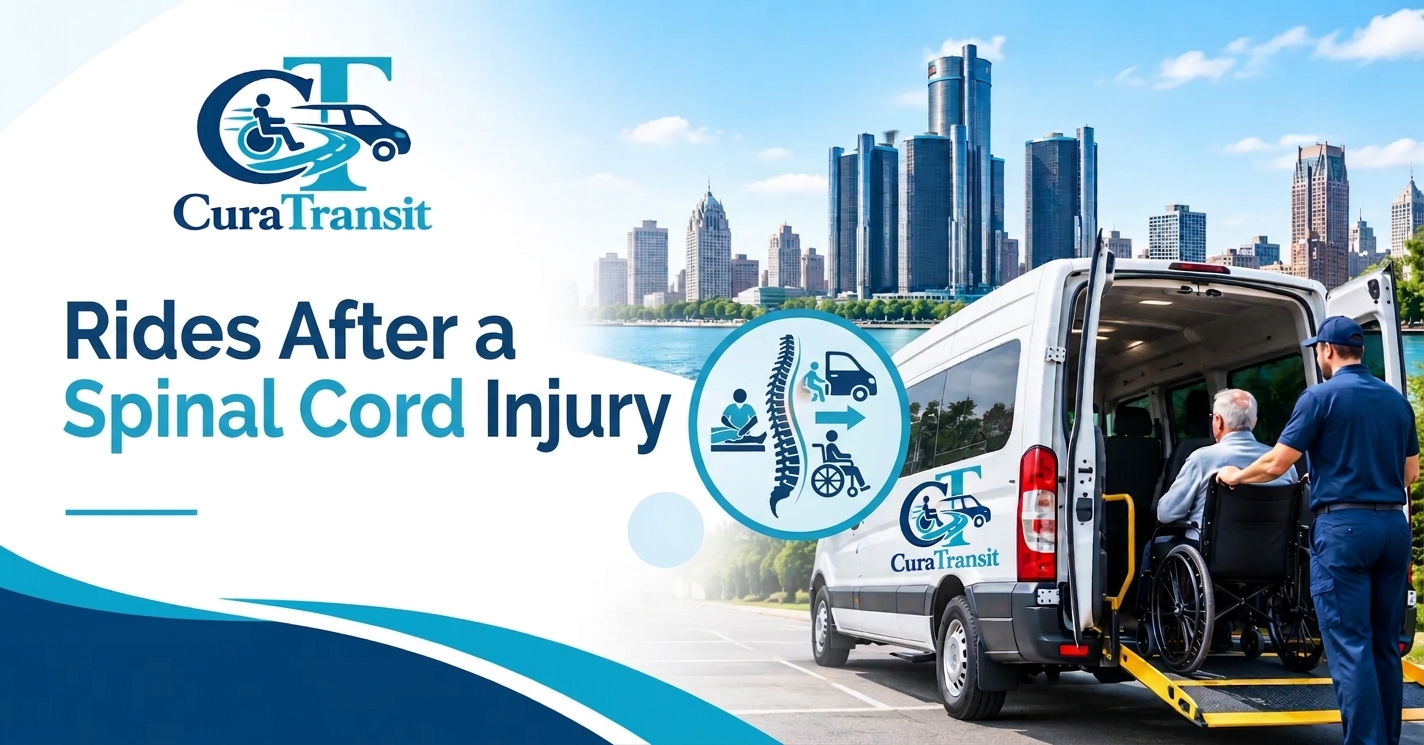
- Power chairs are big and heavy. A power chair with tilt, recline or custom seating can't be folded into a trunk. It needs a ramp or lift and a securement system.
- Skin and positioning matter. NINDS notes that pressure injuries come from continuous pressure and are prevented by changing position regularly. Long waits for a late ride add sitting time the treating team didn't plan for.
- Some symptoms need a plan. Autonomic dysreflexia, a dangerous reflex reaction that mainly affects people with neck or upper-back injuries, can come on suddenly. The passenger and family should know the plan, and the team should decide whether a companion needs to ride along.
- The appointments never really stop. Rehab tapers off, but follow-ups, equipment fittings and specialist visits keep going for years.
That's why transportation after a spinal cord injury in Metro Detroit works best when it's planned once, with all the details written down, and then repeated reliably.
Which vehicle does a spinal cord injury survivor need?
The right ride depends on how the person moves and sits, not on the level of injury alone. The treating team or case manager is the best judge. This table is a starting point.
| Situation | Usually the right ride | What to ask for |
|---|---|---|
| Uses a power wheelchair (with or without tilt or recline) | Wheelchair van for spinal cord injury survivors: ramp or lift entry | Passenger stays in their own chair; chair secured to the floor; enough headroom for the seated height |
| Uses a manual wheelchair and can't transfer easily | Wheelchair-accessible van | No transfer needed; the driver helps with the ramp and securement |
| Incomplete injury, walks with a walker or cane for short distances | Ambulatory transportation | Door-to-door help; a driver who walks them to check-in |
| Must lie flat or needs medical monitoring on the way | Ambulance, not an NEMT van | CuraTransit does not provide stretcher or ambulance transport |
Mobility often changes during recovery. Someone might start in a power chair and move to a manual chair or a walker. Tell us when it changes and we'll switch the ride type for future trips.
What to tell the ride provider before the first trip
A first ride goes smoothly when the driver knows what to expect. Have this ready when you book power wheelchair transportation to appointments:
- The chair. Manual or power; make and model if you know it; whether it tilts or reclines; any headrest, tray or other equipment mounted on it; and roughly how tall the passenger sits in it.
- The passenger. Preferred name, whether they can speak up if something is wrong, and whether they use a seat belt, chest strap or positioning belt on the chair.
- The plan from the treating team. Any instructions about positioning, pressure relief or symptoms to watch for. CuraTransit drivers are trained and background-checked, but they don't provide medical care. If the plan says the passenger shouldn't travel alone, a family member or attendant rides along, and we reserve the seat when you book.
- The pickup and drop-off. Which door, whether there's a ramp at home, where the clinic's accessible entrance is, and who receives the passenger at the other end.
- The schedule and payer. Every recurring appointment, plus the insurer, claim number and adjuster or case manager contact.
In a Michigan winter, ask for a call when the driver is close, so the passenger isn't waiting outside in the cold or on an icy ramp.
How Michigan no-fault usually pays for spinal cord injury rides
For most crash survivors, no-fault transportation for spinal cord injury treatment comes under personal injury protection (PIP) allowable expenses, which cover reasonably necessary care, recovery and rehabilitation. Transportation to and from treatment is part of that. A few points matter more for SCI claims than most:
- The coverage level depends on the policy. For policies issued or renewed after July 1, 2020, drivers choose a PIP medical level: unlimited, $500,000, $250,000 or a lower option if they qualify (State of Michigan: choosing PIP medical coverage). An SCI claim can use a lot of a capped limit, so the adjuster or case manager should confirm what's left. Our Michigan no-fault medical transportation guide explains the levels and deadlines.
- Rides and a van are different expenses. In Admire v. Auto-Owners (2013), the Michigan Supreme Court held that the base price of a van is not an allowable expense under MCL 500.3107(1)(a). The insurer in that case had paid for the wheelchair modifications and mileage to medical appointments. In plain terms: families buying their own accessible vehicle often pay for the vehicle itself, and getting one can take months. Rides from a provider fill that gap.
- Documentation keeps rides paid. Insurers want rides tied to prescribed, accident-related treatment. A therapy schedule or plan of care from the treating provider is the most useful thing you can send.
- No auto insurance? Survivors with no applicable policy may be able to claim through the Michigan Assigned Claims Plan. See our MACP medical transportation guide.
CuraTransit verifies transportation benefits with the insurer before rides are billed to the claim. If the claim is still pending, private pay can cover the first rides, and we quote before booking.
Getting discharged from inpatient rehab soon? Call 248-320-9092 or book online with the discharge date, the chair details and the claim number. We'll line up the ride home and the first weeks of therapy rides.
Rides to spinal cord injury rehab across Wayne, Oakland and Macomb
SCI care in Metro Detroit is spread out, so routes often cross county lines. The Rehabilitation Institute of Michigan, for example, runs a 94-bed inpatient hospital at the Detroit Medical Center and lists more than 30 outpatient therapy sites in southeastern Michigan. Its spinal cord injury program is CARF-accredited as a Spinal Cord Specialty Program. Its Sterling Heights center on Schoenherr Road in Macomb County also lists a spinal cord injury program. A survivor might go from inpatient care in Midtown Detroit to outpatient therapy near home in the suburbs. (CuraTransit is an independent provider. We mention these programs because our riders go there, not because of any partnership.)
We cover rides to spinal cord injury rehab and follow-up care across the region:
- Wayne County: Detroit, Dearborn, Livonia and the rest of Wayne County.
- Oakland County: our home base in Southfield, plus Troy, Royal Oak, Farmington Hills and Novi.
- Macomb County: Sterling Heights, Warren and Clinton Township.
Trips outside the three counties are quoted case by case depending on distance.
Recurring rides: how to keep a long schedule on track
SCI recovery is measured in months and years, so the transportation plan has to last. What works:
- Book standing rides once. We set recurring days and times and keep them on the calendar, so no one rebooks every week.
- Ask for the same driver where possible. We assign consistent drivers for recurring rides whenever we can. A driver who already knows the chair and the house saves time and stress at every pickup.
- Match the return to the session. A set return time beats "call when you're done", and it keeps sitting time down.
- Name one contact for changes. Usually a family member or the case manager. Therapy schedules shift, and one contact keeps the driver from showing up for a cancelled visit.
- Update the chair details. New wheelchairs, cushions and seating changes are common in the first year. Tell us before the next ride, not at the curb.
For case managers, adjusters and law firms
Catastrophic auto claims often involve a nurse case manager coordinating many providers, and missed appointments raise questions in the file. When you refer a spinal cord injury client to CuraTransit, we can:
- verify transportation benefits with the insurer or MACP-assigned carrier before billing the claim;
- arrange the ride home from inpatient rehab and set up standing therapy rides from day one (see hospital discharge transportation);
- record the chair, positioning and handoff details once, so every driver has them;
- reserve a companion seat for an attendant or family member;
- confirm schedule changes with the contact you name.
If you coordinate several clients, our referral partner page explains how case managers, rehab programs and facilities work with us. You can also reach the team through our contact page. For survivors with other injuries from the same crash, our guide to brain injury rehab transportation covers supervision and day programs.
Frequently asked questions
Does Michigan no-fault pay for transportation after a spinal cord injury?
Usually, yes. Rides to accident-related treatment are generally an allowable expense under no-fault PIP, as long as the treatment is reasonably necessary and the policy's PIP medical limit hasn't been used up. Confirm coverage with the adjuster before rides start.
Can I stay in my power wheelchair during the ride?
Yes. In a wheelchair-accessible van the passenger stays seated in their own manual or power wheelchair, which is secured to the vehicle floor. Tell us the chair's details and the passenger's seated height when you book.
Will no-fault buy me a wheelchair van?
Not usually the vehicle itself. In Admire v. Auto-Owners (2013), the Michigan Supreme Court held that a van's base price is not an allowable expense, though the insurer there paid for modifications and mileage. Ask your attorney or adjuster about your claim. Provider rides can cover appointments in the meantime.
Can a family member or attendant ride along?
Yes. Mention it when you book and we'll reserve the seat. Because drivers don't provide medical or attendant care, a companion is the right choice when the treating team says the passenger shouldn't travel alone.
Can you take my loved one home from inpatient rehab?
Yes. If they can travel seated in a wheelchair or walk with help, we can do the discharge ride and set up the first therapy rides at the same time. Share the discharge date and the claim details as early as you can.
What if the survivor has no auto insurance?
They may be able to apply for benefits through the Michigan Assigned Claims Plan (MACP). CuraTransit accepts eligible MACP cases after the claim is assigned and benefits are verified. Private pay is available while a claim is pending.
Do you transport patients who need a stretcher?
No. CuraTransit provides wheelchair-accessible and ambulatory transportation only. Patients who must lie flat or need medical monitoring on the way should use an ambulance.
Every appointment counts after a spinal cord injury
Recovery after a spinal cord injury is a long series of appointments, and each one only helps if the survivor gets there. Whether the rides are covered by Michigan no-fault, an MACP claim, a facility contract or private pay, CuraTransit turns that schedule into dependable, door-to-door spinal cord injury transportation across Wayne, Oakland and Macomb Counties.
Call 248-320-9092, book a ride online, or see insurance and payment options. Case managers and rehab programs can partner with us for recurring client schedules, and you can learn more about our auto accident transportation.
Sources: NINDS: Spinal Cord Injury; State of Michigan: Choosing PIP medical coverage; Michigan Supreme Court: Admire v. Auto-Owners Insurance Co. (2013); Rehabilitation Institute of Michigan: Spinal cord injury rehabilitation.
Ready to Book a Ride?
CuraTransit is here for all your medical transportation needs across Metro Detroit.
We accept facility contracts, private pay, Michigan auto no-fault claims and MACP cases.
Further reading
Topics covered
- Spinal cord injury
- Michigan no-fault insurance
- Personal injury protection
- Allowable expenses
- Admire v Auto-Owners
- Rehabilitation Institute of Michigan
- Michigan Assigned Claims Plan
- Nurse case manager
- Wayne County
- Macomb County
CuraTransit Editorial Team
Non-emergency medical transportation specialists in Southfield MI
Written by the CuraTransit team in Southfield, Michigan, who schedule and drive wheelchair-accessible and ambulatory medical rides across Wayne, Oakland & Macomb Counties, Michigan every day.