Quick answer
How do I arrange transportation to brain injury rehab after a car accident in Michigan?
After a crash-related brain injury, rides to rehab are usually an allowable expense under Michigan no-fault PIP. Give your ride provider the claim number, the rehab schedule and any supervision needs. Choose a service with door-to-door help, consistent drivers and room for a companion; CuraTransit sets up recurring rides across Wayne, Oakland and Macomb Counties.
In this guide
- The short answer
- Why brain injury rehab transportation is different
- Which type of ride does a brain injury patient need?
- How Michigan no-fault usually covers rides to brain injury rehab
- How to set up recurring rides to neuro rehab, step by step
- Transportation to a brain injury day program
- Getting to brain injury rehab across Wayne, Oakland and Macomb
- For case managers, adjusters and law firms
- Frequently asked questions
- Plan the rides so the rehab can do its job
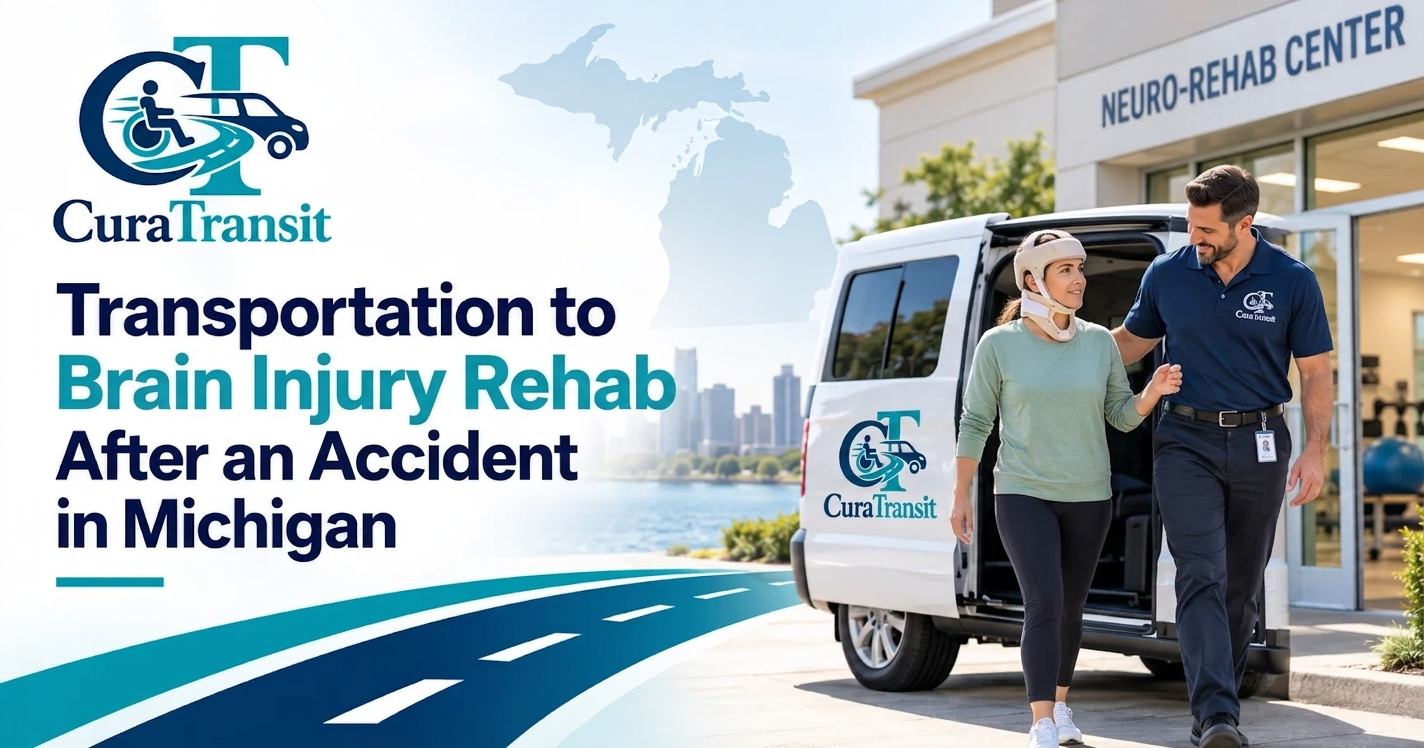
A brain injury from a car accident changes the week in ways people don't expect. There is speech therapy on Monday, occupational therapy on Tuesday, neuropsychology on Thursday, and maybe a day program three mornings a week. The person recovering usually can't drive — often for months — and family members can't take that many hours off work. Reliable brain injury rehab transportation quickly becomes the thing that decides whether the plan of care actually happens.
This guide is for survivors, their families, and the nurse case managers and attorneys who coordinate their care in Metro Detroit. It covers what makes rides for brain injury patients different from an ordinary trip to the doctor, how to choose the right type of ride, how Michigan no-fault usually fits in, and how to set up a schedule that doesn't fall apart in week three.
This article is general information, not medical or legal advice. Questions about a specific claim belong with the insurer or a Michigan auto-accident attorney; questions about safety and supervision belong with the treating team.
The short answer
Rides to accident-related brain injury rehab are usually an allowable expense under Michigan no-fault personal injury protection (PIP). Give your ride provider the claim number, the rehab schedule and any supervision instructions from the treating team. Choose a service that offers door-to-door help, the same driver where possible and room for a companion. CuraTransit sets up recurring auto accident transportation across Wayne, Oakland and Macomb Counties.
Why brain injury rehab transportation is different
Most people think of a medical ride as getting from point A to point B. After a traumatic brain injury (TBI), the trip itself can be part of what makes or breaks a therapy day. Families and case managers tell us the same problems come up again and again:
- Memory and planning. A survivor may forget the appointment, lose track of time, or not be ready at the door. Rideshare apps and taxis don't wait or call ahead.
- Fatigue. Cognitive therapy is tiring. After a two-hour session, a long wait for a return ride or a crowded bus is a lot to ask.
- Sensory overload. Noise, bright light and unfamiliar people can be hard after a brain injury. A calm, predictable ride with a familiar driver helps.
- Safety at the curb. Someone with balance or judgment problems shouldn't be left at a curb or a busy entrance. They need to be walked in and handed off.
- A crowded calendar. Brain injury rehab often means several providers in several places. One missed connection can unravel a whole week.
That's why "any ride will do" usually doesn't work. TBI transportation after a car accident works best when it is planned like part of the treatment plan: same days, same times, same driver where possible, and clear instructions about who meets the passenger at each end.
Which type of ride does a brain injury patient need?
The right vehicle depends on mobility, not on the diagnosis. Many brain injury survivors walk; some use a wheelchair for months; some use one only for longer distances. The treating team or case manager is the best judge, but this table is a good starting point.
| Situation | Usually the right ride | What to ask for |
|---|---|---|
| Walks on their own or with a cane or walker, but can't drive | Ambulatory transportation | Door-to-door help, a driver who walks them to check-in |
| Uses a manual or power wheelchair, or tires quickly when walking | Wheelchair-accessible van | Ramp or lift entry, chair secured, passenger stays in their own chair |
| Needs supervision or reminders during the day | Either of the above, plus a companion | A seat for the attendant, family member or aide who rides along |
| Needs to lie flat or needs medical monitoring en route | Ambulance — not an NEMT van | CuraTransit does not provide stretcher or ambulance transport |
Two practical points. First, CuraTransit drivers are trained and background-checked, but they do not provide medical or attendant care. If the plan of care says the survivor shouldn't be alone, the attendant or family member rides along in the companion seat, and we reserve it when you book. Second, if mobility changes during recovery — wheelchair to walker, for example — tell us and we'll switch the ride type for future trips.
How Michigan no-fault usually covers rides to brain injury rehab
For most Michigan crash survivors, no-fault transportation for brain injury treatment comes under PIP allowable expenses. Michigan's no-fault act requires PIP to pay "reasonable charges incurred for reasonably necessary products, services and accommodations for an injured person's care, recovery, or rehabilitation" (MCL 500.3107). The State of Michigan's auto insurance FAQ lists transportation to and from medical appointments among PIP benefits.
What that means in practice for a brain injury claim:
- Every ride draws from the same PIP medical limit as therapy, attendant care and other allowable expenses. Since the 2019 reform, the coverage level depends on the policy, so the adjuster or case manager should confirm what is available. Our Michigan no-fault medical transportation explainer walks through the coverage levels and deadlines.
- Documentation matters. Insurers want to see that the rides connect to prescribed, accident-related treatment. A rehab schedule or plan of care from the treating provider is the most useful document you can send.
- No auto insurance? Survivors with no applicable policy may be able to claim through the Michigan Assigned Claims Plan. See our MACP medical transportation guide.
- Mileage instead? If a family member does some of the driving, the insurer may reimburse mileage for those trips. Many families mix the two: family drives on days off, and a provider covers the rest.
If the claim is still pending, ask about private pay to cover the first few rides. We quote before booking, so there are no surprises.
How to set up recurring rides to neuro rehab, step by step
- Get the full schedule from the rehab program. Days, times, addresses and expected session length for every therapy — speech, occupational, physical, cognitive and any day program.
- Write down the supervision and handoff instructions. Does the survivor need to be met at the door? Signed in? Handed to a named staff member? Can they wait alone in a lobby?
- Share the claim details. The insurer, claim number and adjuster or case manager contact. CuraTransit verifies transportation benefits with the insurer before rides are billed to the claim.
- Book the standing schedule. We set the recurring rides to neuro rehab once and keep them on the calendar, so no one has to rebook every week.
- Name one contact for changes. Brain injury schedules change often. One person — usually the case manager or a family member — should confirm changes, so the driver never shows up for a cancelled session.
Need rides set up this week? Call 248-320-9092 or book online with the rehab schedule and claim number, and we'll confirm the details with you.
Transportation to a brain injury day program
Day programs — structured, several-hour sessions that work on cognition, daily living skills and community re-entry — are among the hardest trips to keep consistent. They usually start at a fixed time, run most of the day, and expect the participant to be picked up on time at the end.
What works well for transportation to a brain injury day program:
- A fixed pickup window at the same time each program day, with a call or knock at the door rather than a curbside honk.
- The same driver whenever possible. We assign consistent drivers for recurring rides whenever we can. A familiar face lowers anxiety and makes handoffs smoother.
- A clear drop-off point agreed with program staff, and a named person who receives the participant.
- A return time that matches the program's end, not a vague "call us when you're ready."
- Plain notes for the driver: preferred name, how to communicate, what tends to help on a hard day. Share only what the driver needs to know.
Getting to brain injury rehab across Wayne, Oakland and Macomb
Brain injury rehab in Metro Detroit is spread out. Survivors may start at a major center such as the Rehabilitation Institute of Michigan in Midtown Detroit, then move to outpatient therapy or a day program closer to home in the suburbs. Routes often cross county lines, and that's fine. Transportation for TBI patients in Metro Detroit works best when one provider covers the whole region.
- Wayne County — Detroit, Dearborn, Livonia and the Downriver communities. See Detroit and Wayne County.
- Oakland County — our home base in Southfield, plus Farmington Hills, Novi, Troy and Royal Oak.
- Macomb County — Warren, Sterling Heights and Clinton Township.
Trips outside the three counties are quoted case by case depending on distance.
For case managers, adjusters and law firms
Catastrophic and long-term auto claims often involve a nurse case manager coordinating many providers at once. Transportation is one of the services most likely to cause missed appointments, and missed appointments raise questions in the file. When you refer a brain injury client to CuraTransit, we can:
- verify transportation benefits with the insurer or MACP-assigned carrier before billing the claim;
- build standing schedules across several rehab providers;
- reserve a companion seat for an attendant or family member;
- confirm schedule changes with you, the family or the program — not with the survivor alone, unless you tell us otherwise.
If you manage several clients, our referral partner page explains how case managers, rehab programs and facilities work with us. You can also reach the team through our contact page. If the same crash caused a spinal cord injury, see our guide to spinal cord injury transportation for power wheelchair and positioning details.
Frequently asked questions
Does Michigan no-fault pay for transportation to brain injury rehab?
Usually, yes. Rides to accident-related treatment are generally an allowable expense under no-fault PIP, as long as the treatment is reasonably necessary and the policy's PIP medical limit hasn't been used up. Confirm coverage with the adjuster before rides start.
Can a family member or attendant ride along?
Yes. A companion, attendant or caregiver can ride along — just mention it when you book so we reserve the seat. CuraTransit drivers don't provide attendant or medical care, so a companion is the right choice when the plan of care calls for supervision.
Will my loved one have the same driver every time?
For recurring rides we assign the same driver whenever possible. Schedules, time off and route changes sometimes mean a different driver, and we tell you ahead of time when we can.
Does a brain injury patient need a wheelchair van?
Only if they use a wheelchair or can't safely walk the distance. Many TBI survivors walk and do well with assisted ambulatory rides. The treating team or case manager can advise; we can switch ride types as recovery progresses.
Can a nurse case manager book and manage the rides?
Yes. Case managers, family members and rehab staff can book, change and cancel rides for a client. We confirm changes with the contact you name.
What if the survivor has no auto insurance?
They may be able to apply for benefits through the Michigan Assigned Claims Plan (MACP). CuraTransit accepts eligible MACP cases after the claim is assigned and benefits are verified. Private pay is also available while a claim is pending.
Do you transport patients who need a stretcher?
No. CuraTransit provides wheelchair-accessible and ambulatory transportation only. Patients who must lie flat or need medical monitoring on the way should use an ambulance.
Plan the rides so the rehab can do its job
Recovery from a brain injury is built one session at a time, and every missed ride is a session lost. Whether the rides are covered by Michigan no-fault, an MACP claim, a facility contract or private pay, CuraTransit can turn a rehab schedule into dependable, door-to-door brain injury rehab transportation across Wayne, Oakland and Macomb Counties.
Call 248-320-9092, book a ride online, or see insurance and payment options. Case managers and rehab programs can partner with us for recurring client schedules.
Sources: Michigan Legislature — MCL 500.3107 (allowable expenses); State of Michigan — Auto Insurance Frequently Asked Questions.
Ready to Book a Ride?
CuraTransit is here for all your medical transportation needs across Metro Detroit.
We accept facility contracts, private pay, Michigan auto no-fault claims and MACP cases.
Further reading
Topics covered
- Traumatic brain injury
- Michigan no-fault insurance
- Personal injury protection
- Allowable expenses
- Michigan Assigned Claims Plan
- Rehabilitation Institute of Michigan
- Nurse case manager
- Wayne County
- Oakland County
- Macomb County
CuraTransit Editorial Team
Non-emergency medical transportation specialists in Southfield MI
Written by the CuraTransit team in Southfield, Michigan, who schedule and drive wheelchair-accessible and ambulatory medical rides across Wayne, Oakland & Macomb Counties, Michigan every day. Last reviewed November 10, 2026.