Quick answer
Can you use an HSA or FSA to pay for medical transportation?
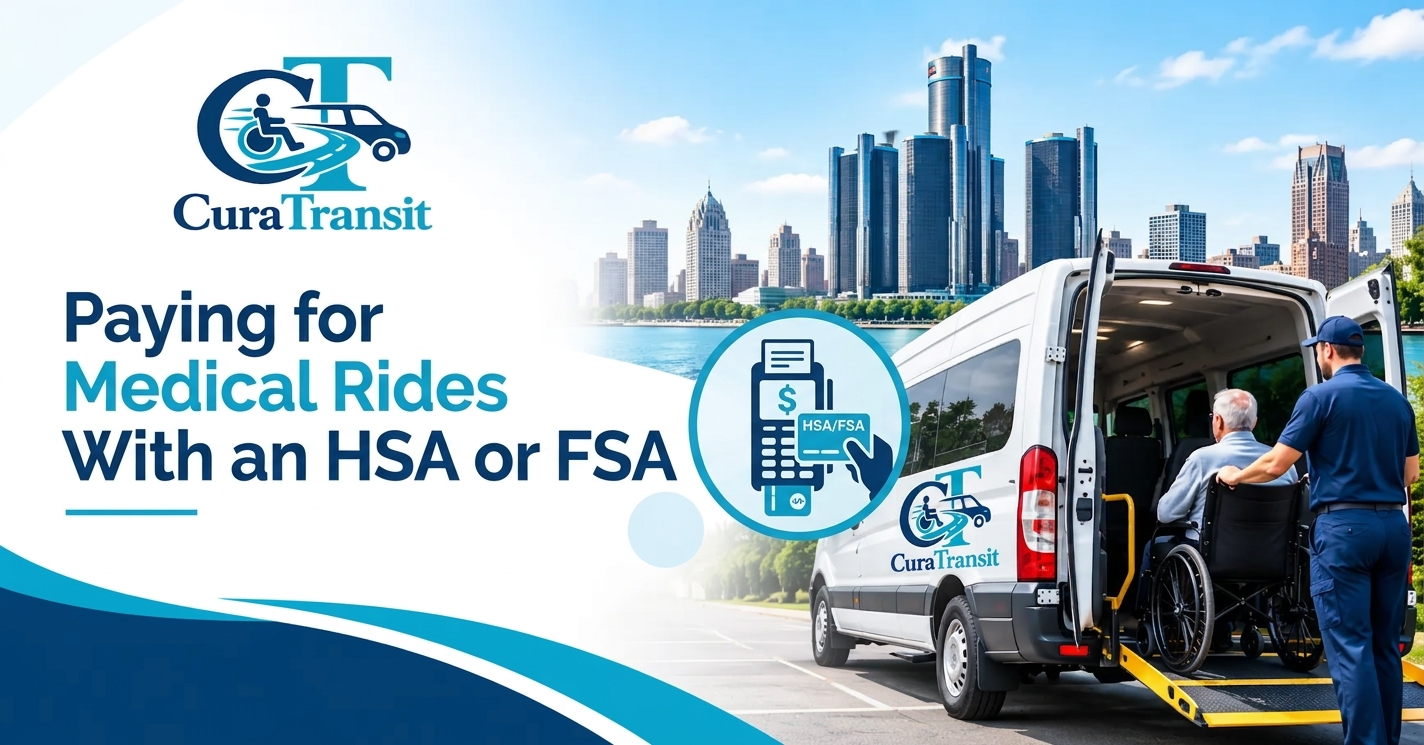
Usually, yes. IRS Publication 502 counts transportation that is primarily for and essential to medical care as a medical expense, which is what HSAs and health FSAs reimburse. A paid wheelchair van or door-to-door ride to an appointment generally qualifies if insurance hasn't paid for it. Keep a receipt for every trip.
In this guide
- The short answer
- What the IRS rules say about transportation
- Is a wheelchair van HSA eligible?
- Whose rides can you pay for? Paying for a parent's rides with an HSA
- HSA vs. FSA vs. HRA: how each one handles medical rides
- Is medical transportation tax deductible?
- Step by step: using an HSA for medical transportation with CuraTransit
- Paying for medical rides across Wayne, Oakland and Macomb
- Frequently asked questions
- Put pre-tax dollars to work on the rides that matter
You've booked your dad a wheelchair van to his cardiology follow-up, and you're paying for it yourself. Then you remember the health savings account sitting in your benefits portal. Can you use the HSA for medical transportation, or is it only for prescriptions and copays?
For most families the answer is yes. Under federal tax rules, a ride whose main purpose is getting someone to medical care is a medical expense, and medical expenses are exactly what HSAs and health FSAs are for. There are a few conditions, though: whose care it is, whether insurance already paid, and whether you kept the right paperwork.
This guide explains those rules in plain English for families in Wayne, Oakland and Macomb Counties who pay privately for wheelchair van and door-to-door rides. We're a transportation company, not tax advisers, so treat this as a starting point and check anything unusual with your plan administrator or a tax professional.
The short answer
Usually, yes. IRS Publication 502 says you can include amounts paid for transportation primarily for and essential to medical care, including taxi and ambulance fares. A paid wheelchair van or door-to-door ride to an appointment fits the same rule, as long as insurance or another source hasn't paid for it. Keep a receipt for every trip. CuraTransit gives private-pay riders a quote before booking: call 248-320-9092 or book a ride.
What the IRS rules say about transportation
HSAs, health FSAs and HRAs all lean on the same definition: the medical and dental expenses described in IRS Publication 502. Its transportation section is short and practical.
Transportation you can include:
- Fares for a bus, taxi, train or plane, and ambulance service, when the trip is primarily for medical care
- Transportation for a parent who must go with a child who needs medical care
- Transportation for a nurse or other person who can give injections, medications or other treatment when the patient can't travel alone
- Out-of-pocket costs of using your own car for medical trips (gas and oil, or the standard medical mileage rate), plus parking fees and tolls
Transportation you can't include:
- Commuting to and from work, even if a medical condition means you need an unusual way of getting there
- Travel that is merely for general health improvement
- Trips to another city for care that you chose for nonmedical reasons only
- Depreciation, insurance, general repairs or maintenance on your own car
A wheelchair van or ambulatory ride to dialysis, physical therapy, imaging or a specialist visit is a paid trip whose whole purpose is medical care, much like a taxi fare in the IRS list. That's why these rides are usually treated as eligible. Your plan administrator still decides each claim.
Is a wheelchair van HSA eligible?
In most cases, yes. A wheelchair van isn't a separate category in the IRS rules. What matters is the purpose of the trip and who pays. The ride is generally eligible when:
- The trip is primarily for medical care. Doctor visits, dialysis, chemotherapy, therapy, labs, imaging and a ride home from the hospital fit. A stop at the grocery store on the way back doesn't, so book errands separately or leave them out of the claim.
- Nobody else paid for it. Pub 502 is clear that you can't include expenses paid by insurance or other sources. If a Michigan no-fault (PIP) claim, an MACP claim or a facility contract covered the ride, don't also claim it from your HSA.
- The patient is someone your account can cover (see the next section).
- You can document it with a receipt showing the date, the trip and the amount paid.
The same reasoning applies to a regular door-to-door ride for someone who walks with a cane or walker but shouldn't drive after a procedure or on new medication.
Whose rides can you pay for? Paying for a parent's rides with an HSA
This is where many families get stuck. IRS Publication 969 says HSA money can be used tax-free for qualified medical expenses of:
- You and your spouse
- Dependents you claim on your tax return
- Certain people you could have claimed as dependents, even if they filed a joint return or had gross income above the limit (Pub 969 lists the exceptions)
Paying for a parent's rides with an HSA works when your parent counts as your dependent under these rules. In practice that usually means you provide more than half of their support. If your mother lives on her own income and you help occasionally, her rides probably aren't a qualified expense from your HSA, even though you're the one paying.
What happens if you get it wrong? Pub 969 says an HSA withdrawal not used for qualified medical expenses is taxable income and may face an additional 20% tax. If you're unsure whether your parent qualifies, ask a tax professional before you swipe the card.
Health FSAs follow a similar list: you, your spouse, dependents and, per Pub 969, your child under age 27 at the end of the year.
HSA vs. FSA vs. HRA: how each one handles medical rides
| HSA | Health FSA | HRA | |
|---|---|---|---|
| Who funds it | You (and sometimes your employer) | Mostly you, through salary reduction | Your employer only |
| Do medical rides qualify? | Generally, if primarily for medical care | Generally, if your plan follows the standard list | Depends on your plan's rules |
| Unused money | Stays in the account year to year | Generally "use it or lose it," with a plan grace period or limited carryover | Some plans carry it over |
| Paperwork | Keep your own records; you don't send them with your return | Plan requires a third-party receipt before it reimburses | Plan requires proof of the expense |
| Prepaying future rides | Withdraw after the ride is paid | No advance reimbursement for future rides | Rides on or after your enrollment date |
FSA eligible medical transportation: the paperwork
Health FSAs are stricter. Pub 969 says the plan must get a written statement from an independent third party showing the expense was incurred and its amount, plus your statement that it hasn't been paid under another plan. It also can't reimburse you in advance for rides that haven't happened yet. So submit claims after each ride or each month, not for a whole season of dialysis up front.
FSAs are generally use-it-or-lose-it. If your plan year is ending and you have a balance left, a parent's upcoming rides to dialysis or therapy may be a sensible use for it, as long as the patient is someone your FSA covers.
Is medical transportation tax deductible?
It can be, but for most families the HSA or FSA does more. Is medical transportation tax deductible? Yes, as an itemized medical expense on Schedule A. But Pub 502 only lets you deduct the part of your total medical and dental costs that's more than 7.5% of your adjusted gross income. Many households never cross that line.
Two rules prevent double-dipping:
- You can't deduct an expense you already paid tax-free from your HSA or FSA.
- If insurance reimburses you in a later year for a ride you deducted, you generally report that reimbursement as income, up to the amount you deducted.
The medical mileage rate for 2026 (when family drives instead)
If a family member drives the patient in their own car, you can count actual gas and oil costs or use the standard rate. According to the IRS standard mileage rates page, the medical mileage rate for 2026 is 20.5 cents a mile from January 1 to June 30 and 23.5 cents a mile from July 1 to December 31. Parking and tolls are added on top.
Here's what that means in practice. A 20-mile round trip in November works out to $4.70 in mileage, plus parking. That's real money over a year of appointments, but it doesn't make a paid ride cheaper. What it does do is let you compare fairly: a family member's time off work isn't a medical expense, but a paid ride to care generally is.
Step by step: using an HSA for medical transportation with CuraTransit
- Call for a private-pay quote. Tell us the pickup address, the appointment, wheelchair or ambulatory, and whether it's one-way, round-trip or recurring. We quote before you book. Our private-pay guide explains how pricing works.
- Mention that you'll submit the ride to an HSA or FSA. That way we know you'll need a receipt for every trip.
- Book 24–48 hours ahead when you can. Same-day rides are sometimes possible depending on availability.
- Pay for the ride. If you can't pay with your HSA card directly, pay another way and reimburse yourself from the HSA afterward. That's allowed as long as the expense is qualified and you keep the record.
- Keep the receipt with your tax records. It should show the date, the passenger, the pickup and drop-off (for example, home in Warren to a clinic in Royal Oak) and the amount paid. For an FSA, upload it to your plan's claims portal.
- Note what the trip was for. A line in your own records like "PT visit, knee surgery recovery" makes an audit or a plan question easy to answer.
For recurring rides, such as three dialysis trips a week, a monthly statement can be easier to manage than a stack of single receipts. Ask your plan whether it accepts one, and ask us when you set up the schedule.
Paying for medical rides across Wayne, Oakland and Macomb
Most of the private-pay families we drive aren't paying for one trip. They're paying for a pattern: a parent in Livonia going to dialysis three times a week, a spouse in Sterling Heights with weeks of radiation, a neighbor in Southfield heading home after outpatient surgery. Over months, that adds up, and paying with pre-tax HSA or FSA dollars can stretch the budget.
CuraTransit picks up across Wayne, Oakland and Macomb Counties, from Detroit and Dearborn to Troy and Clinton Township. We drive to the region's hospital systems and clinics. Longer trips outside the three counties are quoted case by case.
Before you use an HSA, check whether someone else should be paying:
- Car-accident injuries: rides to treatment may be covered under Michigan no-fault or MACP benefits after verification, so the HSA shouldn't pay for them.
- Facility residents: a hospital, dialysis center or senior community may already have a facility contract that covers outside appointments.
- Everything else: private pay, ideally from your HSA or FSA. See all four payment paths on our insurance and payment page, or compare typical prices in our Michigan medical transportation cost guide.
Frequently asked questions
Can I use my HSA to pay for a wheelchair van?
Generally, yes, when the ride is primarily for medical care and no insurer or other source paid for it. IRS Publication 502 counts transportation essential to medical care as a medical expense, and HSAs reimburse those expenses. Keep the receipt.
Is an Uber or taxi to the doctor HSA eligible?
Pub 502 lists taxi fares for medical care as an includible expense, and a rideshare trip to an appointment serves the same purpose, but check how your plan handles it. A rideshare driver can't help with a wheelchair or walk someone to the door, though. For that, a wheelchair van or door-to-door ride is the safer choice.
Can I use my HSA for my mother's medical rides?
Only if your mother counts as your dependent under the HSA rules in IRS Publication 969, which usually means you provide more than half of her support. If she doesn't qualify, an HSA withdrawal for her rides is taxable and may face an additional 20% tax.
Do I need a letter of medical necessity for medical transportation?
Pub 502's transportation rules don't mention one, but each plan sets its own claim requirements, and some FSA and HRA plans ask for extra documentation such as a note from the doctor. Check your plan's rules before you submit the claim.
Can I use FSA money to prepay a month of rides?
No. Pub 969 says a health FSA can't reimburse future or projected expenses. Submit each ride, or a monthly statement, after the trips have happened.
Can I use my HSA for rides that no-fault insurance already paid?
No. You can't include expenses paid by insurance or another source. If a Michigan no-fault or MACP claim covered the ride, it isn't a qualified HSA expense for you.
Does CuraTransit accept private pay for HSA and FSA users?
Yes. We quote private-pay wheelchair van and ambulatory rides before booking across Wayne, Oakland and Macomb Counties. Tell us you'll submit the trip to an HSA or FSA so we know you'll need a receipt for each ride.
Put pre-tax dollars to work on the rides that matter
Using an HSA for medical transportation is one of the simplest ways to make regular rides to dialysis, therapy or specialists easier to afford, as long as the patient is covered, insurance hasn't paid and you keep the receipts. CuraTransit provides wheelchair van and door-to-door rides across Wayne, Oakland and Macomb Counties, paid through private pay, facility contracts, Michigan no-fault claims and MACP after verification. Book a ride, or contact us at 248-320-9092 for a quote.
This article is general information, not tax or legal advice. Rules can change; check IRS guidance, your plan administrator or a tax professional for your situation.
Sources: IRS Publication 502, Medical and Dental Expenses; IRS Publication 969, Health Savings Accounts and Other Tax-Favored Health Plans; IRS: Standard mileage rates.
Ready to Book a Ride?
CuraTransit is here for all your medical transportation needs across Metro Detroit.
We accept facility contracts, private pay, Michigan auto no-fault claims and MACP cases.
Further reading
Topics covered
- Health savings account (HSA)
- Flexible spending account (FSA)
- Health reimbursement arrangement (HRA)
- IRS Publication 502
- IRS Publication 969
- Standard medical mileage rate
- Private pay
- Wheelchair-accessible van
- Wayne County
- Oakland County
- Macomb County
CuraTransit Editorial Team
Non-emergency medical transportation specialists in Southfield MI
Written by the CuraTransit team in Southfield, Michigan, who schedule and drive wheelchair-accessible and ambulatory medical rides across Wayne, Oakland & Macomb Counties, Michigan every day.