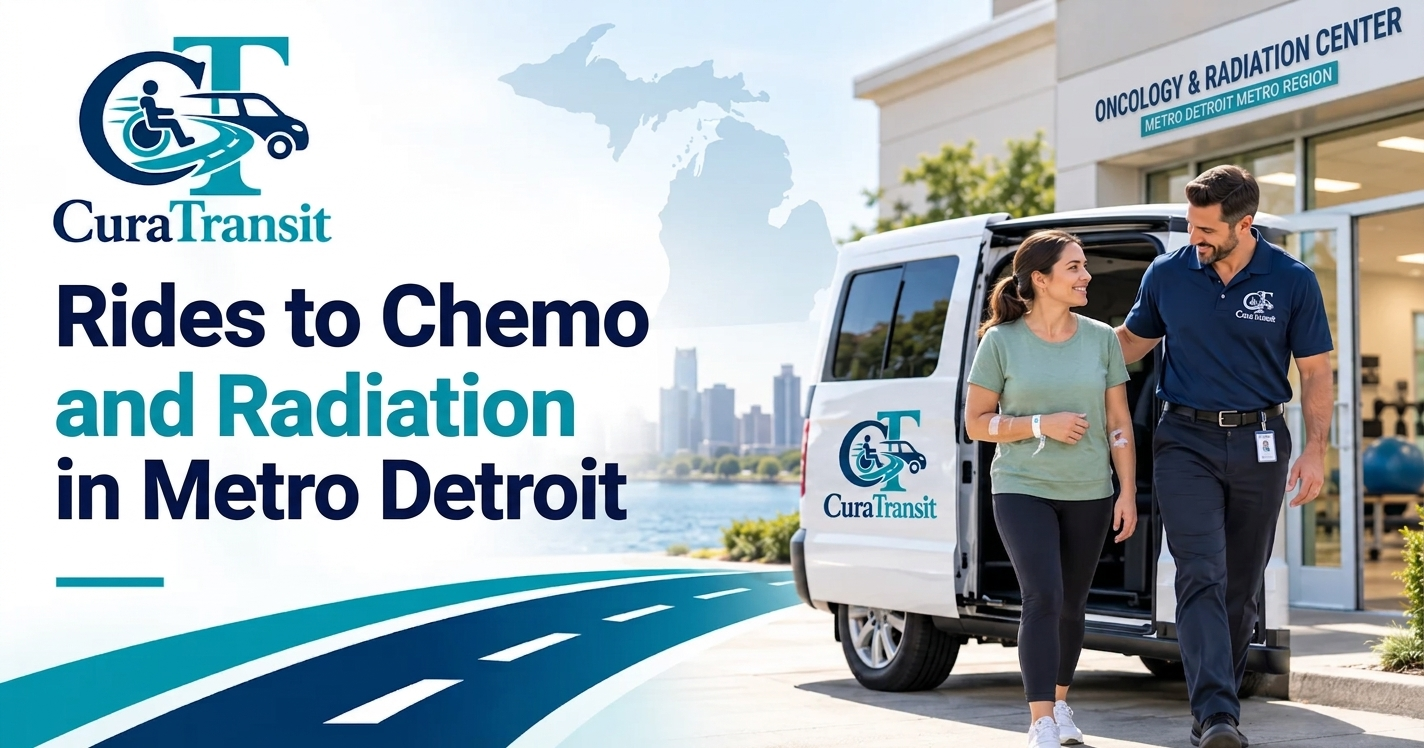
Quick answer
How can I get reliable transportation to cancer treatment in Metro Detroit?
Book a standing, door-to-door schedule that matches your treatment plan: return rides that flex with infusion end times for chemo, and a fixed daily slot for radiation. Ask your cancer center's navigator about help first, then use a wheelchair or ambulatory van paid by private pay, a facility arrangement, or no-fault if accident-related.
In this guide
- The short answer
- Why rides to cancer treatment are harder than an ordinary appointment
- How to plan rides to chemotherapy appointments
- Planning daily radiation trips
- Wheelchair transportation to radiation therapy and infusions
- Where to look for help getting to cancer treatment
- Cancer centers we drive to in Wayne, Oakland and Macomb Counties
- How rides to cancer treatment can be paid for
- For oncology navigators, social workers and infusion center managers
- Frequently asked questions
- Focus on treatment and let us handle the rides
A cancer diagnosis comes with a calendar. Chemotherapy may mean an infusion every week or every few weeks for months, and radiation is often scheduled every weekday for several weeks in a row. Each visit needs a ride there and a ride home, and the ride home usually comes when you feel your worst.
This guide covers transportation to cancer treatment in Wayne, Oakland and Macomb Counties: how chemo and radiation schedules shape your rides, which questions to ask your cancer center first, what changes if you use a wheelchair, and how the ride can be paid for. CuraTransit is a non-emergency medical transportation company based in Southfield. We drive patients to treatment centers across Metro Detroit every week, so this is practical advice, not a list of phone numbers.
The short answer
Set up a standing ride schedule that matches your treatment plan before your first visit. For chemotherapy, plan a return ride that can move when the infusion runs long. For radiation, book the same daily time slot. Ask your cancer center's patient navigator about transportation help first, then use a door-to-door medical appointment transportation service for the trips that family and volunteers can't cover.
Why rides to cancer treatment are harder than an ordinary appointment
Most people can get a neighbor or a relative to drive them to one doctor visit. Cancer treatment is different for four reasons:
- The number of trips. A treatment plan can mean dozens of round trips. Even supportive family members run out of vacation days.
- Unpredictable end times. Infusion days include check-in, lab work, a visit with the oncologist, pre-medications and the infusion itself. Any step can run late, so the ride home is hard to time.
- How you feel afterward. Fatigue and nausea are common side effects of treatment. Some pre-medications can make you drowsy. Ask your care team whether you should drive yourself on treatment days. Many patients are told not to.
- Infection risk. When chemotherapy lowers your blood counts, your care team may ask you to avoid crowds. A direct ride with no other passengers can help with that.
The American Cancer Society has said the same thing in its own words. When it funded a transportation grant at Karmanos, it noted that "some patients don't have access to transportation or are too fatigued or sick to drive themselves" (Karmanos Cancer Institute, 2022).
How to plan rides to chemotherapy appointments
Rides to chemotherapy appointments work best when the driver knows what kind of day it is. When you book, tell the transportation company:
- Your arrival time, not your infusion time. Most centers want you there before your lab draw or check-in. Use the time on your appointment letter.
- The expected length of the visit. Ask the infusion nurse how long your regimen usually takes, and pass that estimate on when you book.
- That the return time may change. CuraTransit sets the return pickup from your estimate. If the infusion runs long, call us when you're nearly done and we adjust the pickup.
- Which entrance to use. Large cancer centers have several doors and parking structures. A driver who knows to meet you at the infusion entrance saves you a long walk.
- Whether someone is coming with you. A family member can usually ride along. Just tell us when you book.
- Whether you were sedated or had a procedure. Some clinics will release you only to a person who walks you out. Our drivers provide door-to-door help.
If you have a take-home pump or feel unwell at the end of the visit, mention it. The driver can plan for a slower walk to the van and a few extra minutes at your door.
Planning daily radiation trips
Radiation is a different pattern: short visits, often at the same time every weekday for several weeks. That makes it a good fit for a standing ride, one booking that repeats until treatment ends. The benefits are simple:
- The same pickup time every day, with no daily phone calls.
- A familiar driver whenever possible. CuraTransit assigns the same driver to recurring rides when it can.
- One call to pause the schedule if your oncologist puts treatment on hold, and one call to restart it.
If your radiation time changes partway through, call as soon as the center tells you so we can move the standing ride.
Wheelchair transportation to radiation therapy and infusions
For patients who use a wheelchair, the ride gets harder. Volunteer drivers using their own cars, and most rideshares, can't carry a person who needs to stay seated in a wheelchair. Folding a chair and transferring in and out of a sedan twice a day is exhausting on treatment days.
Wheelchair transportation to radiation therapy or an infusion center solves that. In a wheelchair-accessible van, you stay in your own manual or power wheelchair. The driver secures the chair, helps you from your door to the clinic entrance and brings you back the same way. If you walk with a cane or walker but tire easily, ambulatory transportation gives you the same door-to-door help without the ramp.
CuraTransit does not provide stretcher transport. If a patient must lie flat during travel, the cancer center will arrange an ambulance.
Where to look for help getting to cancer treatment
Before you pay for every ride, check what is available to you. Help getting to cancer treatment usually comes from a mix of sources:
| Option | Best for | Things to know |
|---|---|---|
| Your cancer center's patient navigator or social worker | Everyone. Ask first | Navigators know the center's own programs and local charity rides |
| American Cancer Society programs | Patients who can get in and out of a car on their own | Availability depends on volunteers in your area; ask ACS or your navigator |
| Family and friends | Occasional trips | Hard to sustain over months of weekly visits |
| Paratransit (DDOT or SMART) | Certified riders on flexible schedules | Shared rides and pickup windows. See our paratransit comparison |
| Private wheelchair or ambulatory van | Recurring visits, wheelchair users, long or unpredictable days | Door-to-door, direct ride, paid by private pay, a facility arrangement, or no-fault/MACP when accident-related |
Karmanos, for example, tells patients who need transportation help for appointments there to contact their patient navigator at 1-800-KARMANOS. Most large cancer programs in the region have a navigator or social worker who can tell you what's available.
Most families end up with a mix: volunteers or relatives for some trips, and a dependable van service for infusion days, daily radiation, or anyone who rides in a wheelchair. If that's where you are, call 248-320-9092 and we'll help you plan the schedule.
Cancer centers we drive to in Wayne, Oakland and Macomb Counties
CuraTransit picks up anywhere in the three counties and drives to hospitals and cancer centers across the region, including:
- Karmanos Cancer Institute in Midtown Detroit, at 4100 John R, plus Karmanos network locations at McLaren hospitals in the suburbs. Karmanos Cancer Institute transportation questions about the center's own help go to your navigator. For rides we provide, call us.
- Henry Ford Cancer Institute, including the Brigitte Harris Cancer Pavilion in Detroit's New Center. It opened in January 2021 and is linked to Henry Ford Hospital by a skywalk over West Grand Boulevard (Henry Ford Health).
- Corewell Health cancer care at its Royal Oak hospital campus and other Corewell Health locations in Oakland and Wayne Counties.
- Trinity Health, the DMC and independent infusion and radiation clinics in places like Southfield, Troy and Clinton Township.
Trips to a cancer center outside the three counties are quoted case by case, depending on distance.
How rides to cancer treatment can be paid for
CuraTransit works with four payment paths. Not every one applies to every patient, so here's an honest breakdown:
- Private pay. The most common path for cancer treatment rides. We give you a quote before booking, and a recurring schedule makes the total easy to plan. See private pay medical transportation for how it works.
- Facility arrangements. Cancer centers, infusion clinics, hospices and senior communities can set up rides through a facility contract, so the patient doesn't have to arrange each trip.
- Michigan no-fault (PIP). No-fault covers transportation only for care related to a car accident. It does not pay for cancer treatment. If a patient is also recovering from an accident, those accident-related rides may be covered once benefits are verified. See Michigan no-fault medical transportation.
- MACP. The same rule applies: the Michigan Assigned Claims Plan covers eligible accident-related care only.
Compare all four on our insurance and payment page.
For oncology navigators, social workers and infusion center managers
Missed treatment visits disrupt care plans and chair schedules. If your patients struggle with transportation, a facility account can help:
- Standing orders for patients on weekly chemo or daily radiation.
- Flexible return pickups when infusions run long. Your staff calls once and we adjust.
- Wheelchair and ambulatory vans for patients who can't use volunteer car programs.
- One point of contact and consolidated billing for the rides you cover.
Learn how facility contracts work on our partners page, or contact us to talk through your patient volume.
Frequently asked questions
Can I drive myself to chemotherapy?
Some patients can, but many are told not to. Fatigue, nausea and drowsy pre-medications make driving home risky. Ask your oncology team about your specific regimen, and plan a ride for at least your first infusion until you know how you'll feel.
What happens if my infusion runs longer than expected?
With CuraTransit, the return pickup is set from your estimated end time. If the infusion runs long, call us when you're nearly finished and we'll adjust the pickup so you aren't waiting at the curb.
Can you set up a daily ride for radiation?
Yes. We can book a standing ride at the same time each weekday for the length of your radiation plan, and pause or restart it with one call if your schedule changes.
Do you provide wheelchair transportation to cancer treatment?
Yes. Our wheelchair-accessible vans carry you in your own manual or power wheelchair, with door-to-door help at both ends. We do not provide stretcher transport.
Does car insurance pay for rides to cancer treatment in Michigan?
Generally no. Michigan no-fault and MACP cover transportation only for treatment related to a car accident. For cancer care, the usual paths are private pay or a ride arranged by the facility.
Can a family member ride with me?
Usually, yes. Many patients like having someone with them on infusion days. Tell us when you book so we plan the seating.
Which areas do you serve?
We serve all of Wayne, Oakland and Macomb Counties from our office in Southfield. Longer trips outside the three counties are quoted case by case.
Focus on treatment and let us handle the rides
Getting to cancer treatment shouldn't be the hardest part of your week. CuraTransit provides reliable, door-to-door transportation to cancer treatment across Metro Detroit, in wheelchair-accessible and ambulatory vans, on a schedule built around your treatment plan. We work with private pay, facility contracts, Michigan no-fault claims and MACP for eligible accident-related care.
Call 248-320-9092, book a ride online, or contact us to set up a recurring schedule before your first visit.
Sources: Karmanos Cancer Institute — The American Cancer Society awards transportation grant to Karmanos Cancer Institute (May 2022); Henry Ford Health — Henry Ford Cancer Institute set to begin patient care at Brigitte Harris Cancer Pavilion (January 2021).
Ready to Book a Ride?
CuraTransit is here for all your medical transportation needs across Metro Detroit.
We accept facility contracts, private pay, Michigan auto no-fault claims and MACP cases.
Further reading
Topics covered
- Karmanos Cancer Institute
- Henry Ford Cancer Institute
- Brigitte Harris Cancer Pavilion
- Corewell Health
- American Cancer Society
- Chemotherapy
- Radiation therapy
- Detroit
- Oakland County
- Macomb County
CuraTransit Editorial Team
Non-emergency medical transportation specialists in Southfield MI
Written by the CuraTransit team in Southfield, Michigan, who schedule and drive wheelchair-accessible and ambulatory medical rides across Wayne, Oakland & Macomb Counties, Michigan every day.